Showing posts with label series. Show all posts

Wednesday, April 30, 2014

9.4 Mathematical Induction

mathematical induction - means of proving a theorem by showing that if it is true of any particular case, it is true of the next case in a series, and then showing that it is indeed true in one particular case

Steps to Mathematical Induction:

Let P(n) be a statement involving the positive integer n.

1.) Show that P(1) is true.

2.) Assume P(n) is true for n.

3.) Show that is is true for n+1.


Example

P(n) = 1 + 3 + 5 + 7 +...+ (2n-1) = n^2

Step 1: Show it is true for n=1.

P(1) = 1 = 1^2
          1 = 1

Step 2:  Assume P(n) is true.

P(n) = 1 + 3 + 5 + 7 +...+ (2n-1) = n^2 

Step 3: Show it is true for n+1.

1 +3 + 5 + 7 +...+ (2n-1) + [2(n+1) - 1] = (n+1)^2 
                                     n^2 + 2n + 1 = n^2 + 2n + 1 

*Since 1 + 3 + 5 + 7 +...+ (2n-1) = n^2, you can substitute 1 +3 + 5 + 7 +...+ (2n-1)  for n^2*

Tuesday, April 22, 2014

9.1 Sequences and Series


Sequence: Function whose domain is the set of positive integers.
 
Finding the First Four Terms of a Sequence
1.     an=5n-3
a1=5(1)-3=2
a2=5(2)-3=7
a3=5(3)-3=12
a4=5(4)-3=17
2.     an=3 + (-2)n
a1=3 + (-2)1 = 1
a2=3 + (-2)2 = 7
a3=3 + (-2)3 = -5
a4=3 + (-2)4 = 19
Finding the nth Term of a Sequence

      1.     2, 8, 18, 32, …
Each term is twice the square of n
2n2


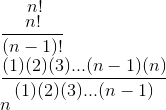
Factorials
n! = (1) (2) (3) (4) (5) ... (n-1) (n)
 
Using Factorials
1.     5!
(5) (4) (3) (2) (1)
120
 2.


Series: Sum of the terms of an infinite sequence.
 
Finding the Sum of a Series