Showing posts with label polynomial functions. Show all posts

Friday, January 24, 2014

2.3 Real Zeroes of Polynomial Functions

This section contains information on long division of polynomials, synthetic division, the remainder theorem and the rational zero test.


Long Division of Polynomials

One way to divide polynomials by other polynomials is to use long division.
Example: Divide by x+3


After dividing, we can tell that the remainder is zero because there are no numbers that are left over. Since we know (x+3)(2x+4)=we can find the x intercepts of the graph:

(x+3) (2x+4)
x+3=0   2x+4=0
x=-3      x=-4/2
              x=-2

The x intercepts are located on the graph at x=-3 and x=-2.
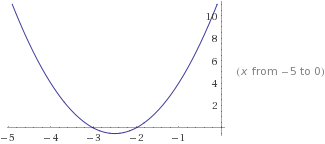

When dividing polynomials, sometimes there will be a remainder that is left over.
Example: Divide by x+2


In this equation, the remainder is -23. The answer to this problem can be written as:


Synthetic Division

Synthetic division is another method you can use when finding the zeroes of polynomials.
Example: Divide  by x+3


Setting it up: 1. The divisor is x+3 which means that x=-3. The -3 is placed to the left.
                    2. The coefficients of the dividend are 2, 10 and 12. These numbers are placed in order to the                            right of the -3.

Step 1: Bring down the 2
Step 2: Multiply the 2 by -3= -6
Step 3: Add 10 + (-6) = 4
Step 4: Multiply the 4 by -3= -12
Step 5: Add 12 + (-12) = 0


When using synthetic division, multiply the terms going diagonally and then add the terms vertically. x+3 is a factor of the equation because it has no remainder. If there was a remainder, then x+3 would not be a factor.
Example: Divide  by x+5


Since the remainder is 12, x+5 is not a factor.


The Remainder Theorem

The remainder theorem: f(k)=r
If a polynomial f(x) is divided by x-k

Example: Divide  by x+6


Using the remainder theorem we know F(-6) =-65
This tells us that (-6, -65) is a point on the graph of f which can be seen below.


Rational Zero Test

If this polynomial

Has integer coefficients, every rational zero of f can be found using this equation:

p= factors of the constant term 
q= factors of the leading coefficient

Example:  Find all possible rational zeroes o
p= factors of 6
q= factors of 5


*These are only the possible rational zeroes. They can be tested individually using synthetic division to determine if they are actual rational zeroes.
Example: Test x=-1 to see if it is a rational zero


Since there is a remainder of -4, x=-1 is not a rational zero.


Monday, January 20, 2014

2.2 Polynomial Functions of Higher Degree


Graphs of Polynomial Functions

Continuous- the graph has no breaks, holes, or gaps

End Behavior 

The exponent of the first term will determine whether the ends of the polynomial function will move in the same direction or the opposite
  • An even exponent means the ends will be the same (both rise or both fall)
  • An odd exponent means the ends will be opposite (one rises and one falls)


                                                                     Polynomial with a degree of 0


                                                                   Polynomial with a degree of 1

                                                                                      odd = opposite


                                                                        Polynomial with a degree of 2

                                                                                       even = same


                                                                        Polynomial with a degree of 3

                                                                                         odd = opposite


                                                                          Polynomial with a degree of 4 

                                                                                              even = same


                                                                          Polynomial with a degree of 5

                                                                                          odd = opposite


Leading Coefficient Test

     f (x) = 28x6 + 15x3 – 12x2 + 87

  • Leading coefficient = 28
  • The leading coefficient, in this case 28, will tell us whether the right end of the graph will rise or fall
  • A positive coefficient means the right end will rise/ go towards infinity
  • A negative coefficient means the right end will fall/ go towards - infinity


Zeros of Polynomial Functions

A zero of a function f is a number x for which f (x) = 0

An nth degree polynomial will have a maximum of n x-intercepts

A polynomial to the nth degree will have a maximum of n-1 extremas (relative minimums or maximums) 

Example:    f (x) = x3- x


The degree of this polynomial is 3.  The maximum number of extremas this polynomial can have is two because 3 - 1 = 2

A polynomial with a degree of 3 can have zero extremas as well. 

Example:      y = x3 


Thursday, January 16, 2014

Section 2.1- Quadratic FUNctions

Polynomial functions


  • Let n be a non negative integer and let   be real numbers with.
  • The function is called a polynomial function of x with degree n.
  • Polynomial functions are classified by degree.
  • Constant function:
  • It has a degree of 0.
  • Linear function:
  • It has a degree of 1.
  • The type of polynomial function discussed in this section is the quadratic function.

Quadratic Functions

  • Let a, b, and c be real numbers with
  • The graph of a quadratic function is a special type of U shaped curve called a parabola.All parabolas are symmetric with respect to a line called the axis of symmetry.
    • The point where the axis intersects the parabola is the vertex of the parabola.
    • If the leading coefficient a is positive, the graph is a parabola that opens upward. If the leading coefficient a is negative, the graph is a parabola that opens downward.

  • The simplest type of quadratic is
  • In the graph a > 0, the vertex is the minnimum point on the graph; and if a < 0, the vertex is the maximum point on the graph.


  • The Standard form
    • It identifies the vertex of the parabola as (h,k)
      • Ex: 
 (step 1)
 (step 2)
 (step 3)
Vertex = (-2, -9)
  • How to complete the square
    • Step 1: factor out any coefficient of that is different from 1.
    • Step 2: addinside the parentheses and subtract multiplied by the coefficient of outside the parentheses.
    • Step 3: simplify into standard form.
